
Okavango Delta & Moremi
A delta in the middle of the Kalahari whose flood arrives in the dry season: what to know before you drive through Moremi and Khwai.
Home Destinations Botswana Okavango & Moremi
In short
The Okavango Delta in northern Botswana is one of the few large inland deltas in the world: the river never reaches the sea, it ends in the Kalahari. It became a World Heritage Site in 2014, the 1,000th on the UNESCO list. Moremi is the game reserve inside the delta that you explore in your own 4x4. The flood arrives in the middle of the dry season, when the plains fill with water and wildlife gathers. You sleep only at booked, unfenced campsites.
Key facts
The delta and Moremi in numbers
- Location
- Northwestern Botswana, with Maun on its southeastern edge
- World Heritage
- Since 2014, the 1,000th site on the UNESCO list, about 20,200 km²
- Under water
- 3,500 to 10,100 km² depending on the year, 6,600 km² on average (1990–2019)
- Moremi
- Game reserve since 1963, founded by the Batawana, 3,900 to 4,900 km² depending on the source, including Chief’s Island
- Gates
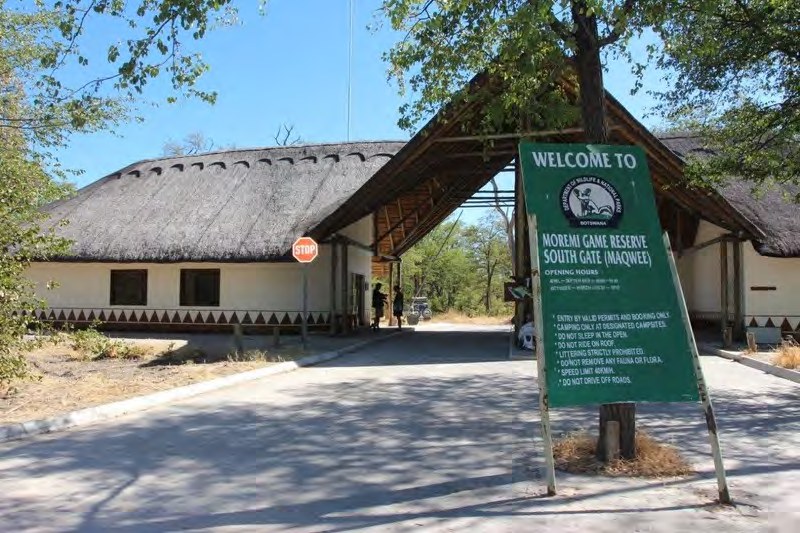
- South Gate (Maqwee) from Maun, North Gate at Khwai
- Open
- April to September 6:00 to 18:30, October to March 5:30 to 19:00
- Entry
- 270 pula per person per day, 115 pula per foreign-registered vehicle (since 2022, increase suspended)
- Camping
- Booking only: South Gate, Xakanaxa, Third Bridge, North Gate

The flood
When the water comes
The flood comes from rain in the Angolan highlands. At the Panhandle near Mohembo it peaks around April and May, and the water takes three to four months to reach Maun. So it arrives in the middle of the dry season, when hardly any rain has fallen in Moremi for months — 93 % of the year’s rain falls there from November to March.
Rainy season in the delta: November – March
Dry season: April – October
Flood at the Panhandle near Mohembo: April – May
Flood near Maun: June – August
Largest flooded area: July – September
Wildlife at the water: June – October
Wild dogs with pups at the den: June – September
Cool nights around 9 °C: June – August
Hot days, 32 °C and above: September – November
Month by month: the best time to visit Botswana →
Areas
Where you travel
You explore Moremi on sand tracks between a handful of campsites. Our journeys come from Maun via South Gate and drive on via Xakanaxa to Khwai.
On the edge
Maun
The town on the delta’s southeastern edge: fuel, shops, workshops and scenic flights over the water. The last place to fill up before Moremi.
South
South Gate
The entrance from Maun, also called Maqwee, with a campsite at the gate. Tracks lead on to Xakanaxa and Third Bridge.
Centre
Third Bridge
Named after a log bridge over a side channel, with the campsite right on the water. In flood years it can be closed for a long time — in 2026 still at the end of May.
On the water
Xakanaxa
Lagoons and channels on the edge of the permanent swamps. Boat trips start from here.
Northeast
Khwai
The community area on Moremi’s northern edge, run by the Khwai Development Trust. Its campsites, such as Magotho, lie outside the reserve, and the Trust’s guides offer mokoro trips.
On the water
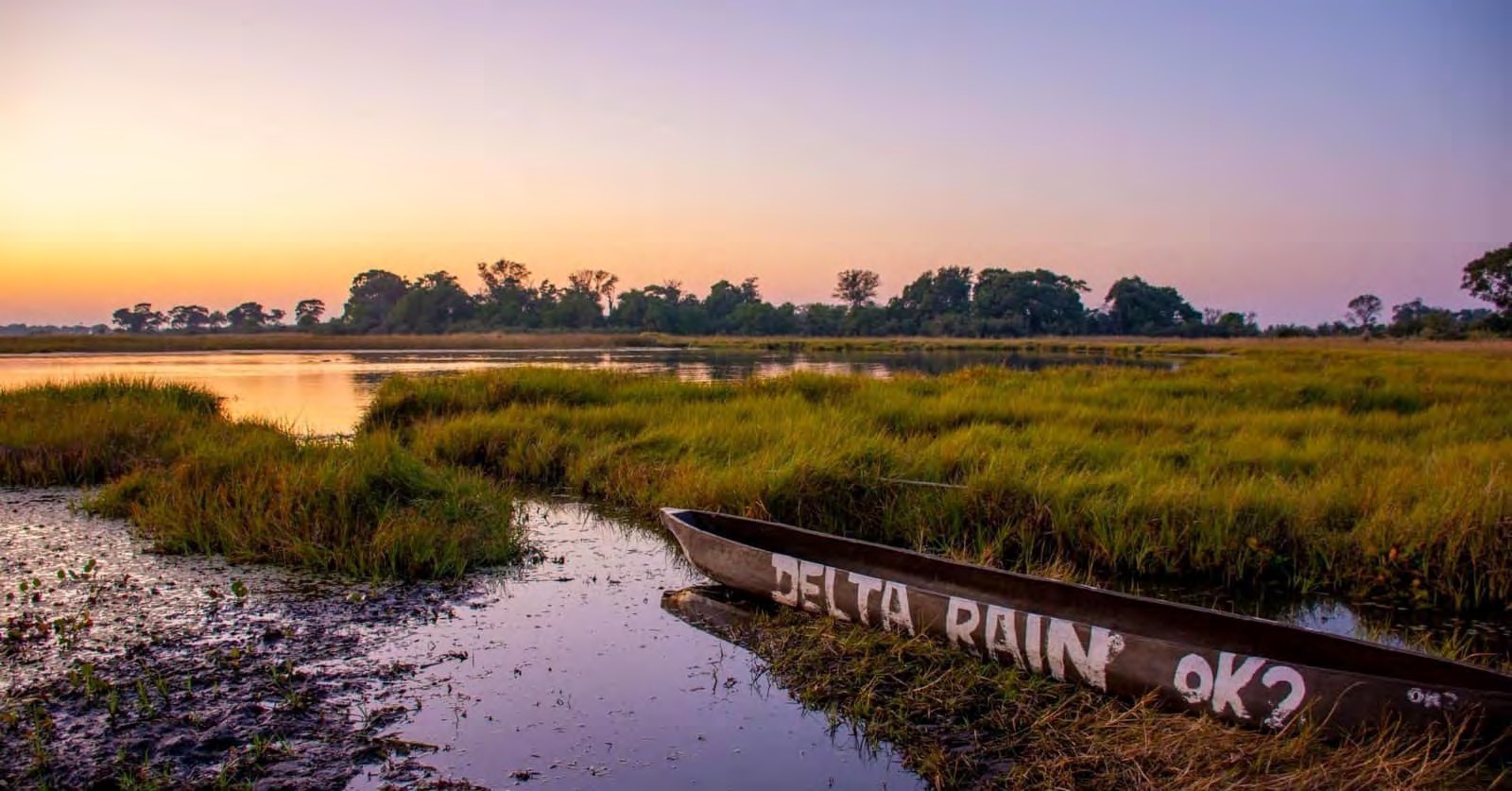
Mokoro
A slim boat that a poler pushes through the shallows with a long pole, standing up — today mostly made of fibreglass. Offered in Boro near Maun and in Khwai, for example.

Wildlife
What you can see
Land and water animals side by side. Some species live only where the water stands.
The African wild dog is endangered: only about 6,600 adults remain worldwide, and one of the largest populations lives in northern Botswana. The red lechwe, an antelope of the floodplains, numbers 26,000 to 33,000 in Botswana. The sitatunga lives in the papyrus swamps and is rarely seen.
Park rules
What applies in Moremi
The rules are set out in Botswana’s National Parks and Game Reserves Regulations and apply to everyone, guides included.
- 01
Daytime only
The gates are open from 6:00 to 18:30 from April to September and from 5:30 to 19:00 from October to March. Between sunset and sunrise you do not drive or leave your campsite.
- 02
Stay on the tracks
Driving off the tracks is prohibited. The speed limit is 40 km/h.
- 03
Stay in the vehicle
Get out only at facilities, in an emergency or to collect firewood. On the road only with a clear view, at least 100 m from dangerous animals and no more than 25 m from the vehicle.
- 04
Booking only
You may spend the night only at a booked campsite. The gate asks for proof.
- 05
No feeding
Feeding animals is prohibited. Fires only in the fireplace, firewood only dead and from the ground — some operators ban collecting altogether.
- 06
Unfenced sites
Animals walk through camp too. Sleep in a tent or the vehicle, never on an elephant or hippo path, and do not swim.
Sources: UNESCO (World Heritage 2014, areas), Remote Sensing 2020 (flooded area 1990–2019), Okavango Research Institute and scientific literature (course of the flood), Botswana Tourism Organisation (Moremi, mokoro, camping advice), National Parks and Game Reserves Regulations (opening hours, booking requirement, park rules), fees since 1 April 2022, Government of Botswana Daily News (2026 increase not in force, 2026 floods), campsite operators Xomae and SKL, Khwai Development Trust, IUCN and PNAS 2022 (wild dog), Koedoe (red lechwe), German Foreign Office (malaria). As of 14 November 2026. Climate figures as in the best-time guide.
Journeys
Five of our journeys drive through Moremi and Khwai. Campsites and permits are booked, and park fees are included in the price.
Journeys through Moremi
View all journeys


Frequently asked
Questions about the delta
When is the best time to visit the Okavango Delta?
For most travellers June to October: the flood is in the delta, it does not rain, and wildlife gathers at the water. June and July bring cool nights; October is the hottest month at 35 °C on average. In the rainy season from November to March the delta is green and empty, wildlife is more spread out, and heavy rain or a high flood can close tracks and campsites.
When does the flood reach the Okavango Delta?
The flood comes from rain in the Angolan highlands. At the Panhandle near Mohembo it peaks around April and May, and the water then takes three to four months for the roughly 250 km to Maun. There it peaks in July and August, and the largest area is flooded from July to September — in the middle of the dry season. How far the water spreads varies a lot: between 1990 and 2019 it was 3,500 km² in the driest year and 10,100 km² in the wettest.
Do you need to book Moremi in advance?
Yes. You may only stay overnight with a booking for a specific campsite, and the gate asks for proof. The sites are run by private operators on behalf of the wildlife department. On our journeys everything is booked.
How much does Moremi cost?
Visitors from outside southern Africa pay 270 pula per person per day, plus 115 pula per day for a foreign-registered vehicle. An increase planned for April 2026 has been suspended. The campsite comes on top: Third Bridge costs 561 pula per person per night in 2026. On our journeys everything is included in the price.
Are the campsites fenced?
No, animals walk through camp too. Botswana Tourism advises sleeping in a tent or the vehicle and never on an elephant or hippo path. On our journeys the guide shows you where to pitch your tent.
What is a mokoro?
A slim boat that a poler pushes through the shallows with a long pole, standing up. It used to be a dugout; today it is mostly fibreglass. Trips are offered in Boro near Maun through a community trust and in Khwai with guides of the Khwai Development Trust, for example. Swimming is not a good idea because of crocodiles and hippos.
What is the difference between Moremi and Khwai?
Moremi is a game reserve run by the wildlife department, with strict rules: daytime driving only, tracks only, overnight stays only at booked sites. Khwai on its northern edge is a community area run by the Khwai Development Trust, with its own campsites outside the reserve.
Is there malaria in the Okavango Delta?
Yes. According to the German Foreign Office the risk in the delta, Moremi and Maun is high from September to May and medium from June to August, and high all year in northern Ngamiland. Get travel-medicine advice before you go.
Read on
More travel guides
When to go
Best time to visit Botswana
Month by month: rain, heat, the flood in the delta and when wildlife gathers at the water.
National park
Chobe & Savuti
Elephants on the river, deep sand at Savuti: areas, tracks and rules in Chobe National Park.
Travel style
Guided self-drive
Drive yourself, but not alone: how it works, what you need and what is different on gravel.
Comparison
Namibia or Botswana?
Desert or delta, gravel or deep sand: the two countries compared, and which one suits whom.

Plan a journey
The delta with us
Tell us when you want to travel — we will suggest the right route through Moremi and Khwai.
Plan a journey